Understanding and improving safety culture is a strategic priority for organisations across industries. Safety culture maturity models provide structured frameworks to assess an organisation’s current safety culture and guide its evolution toward higher-performing and more resilient safety practices. These models enable organisations to diagnose current strengths and weaknesses, establish benchmarks for progress, and implement targeted improvement strategies that align with global expectations of safety performance and leadership accountability.
This detailed article explores the major safety culture maturity models used globally. It explains each model’s structure, stages/levels, theoretical foundation, and practical applications. We also examine the strengths and limitations of these models, helping practitioners, researchers, and safety leaders make informed decisions. Each model’s explanation meets high standards for research-based insights and depth.
Safety Culture Maturity Models
1. DuPont Bradley Curve
Overview
The DuPont Bradley Curve is one of the most widely referenced maturity models in safety culture development. Originally developed by DuPont in the 1990s, it illustrates how organisations evolve from basic compliance to advanced, proactive safety engagement. Although not originally designed as an academic model, it has been widely adopted in safety programs worldwide due to its intuitive structure and actionable insights.
Levels and Explanation
The model outlines four distinct stages of safety culture maturity:
1. Reactive
At this initial level, organisations view safety as a response to accidents. Leaders and employees tend to react only after an incident occurs—the mindset is that “accidents will happen.” There is minimal effort toward prevention beyond meeting basic compliance standards. This reactive approach reflects a culture where safety responsibilities are unclear, and leadership engagement is low.
2. Dependent
In the dependent stage, the organisation begins following established rules, procedures, and policies. Safety is largely driven by management oversight, and compliance becomes paramount. Leadership expects employees to follow safety guidelines, but there is limited personal commitment or ownership of safety outcomes beyond rule adherence. Safety initiatives are still largely top-down.
3. Independent
The independent level marks a significant shift: employees begin to take personal responsibility for safety. Individuals recognise that their behaviour impacts their own safety outcomes. Safety is no longer seen merely as a set of rules but as part of personal accountability. This level often features reduced incident rates due to individual commitment to safer practices.
4. Interdependent
The highest maturity level is interdependence, where safety becomes a collective value. Teams operate with shared responsibility, looking out for one another. Safety discussions transcend individual roles and embed into organisational culture. People actively share safety insights, prevent risks collaboratively, and innovate new safety practices.
Practical Application
The Bradley Curve excels in organisational communication because it visually simplifies complex cultural change into actionable stages. Organisations often use this model to set safety goals, monitor cultural trends over time, and design targeted interventions that encourage progression from compliance-based to values-based safety practices.
Strengths
-
Easy to understand and communicate across all organisational levels.
-
Focuses on behavioural change as a core progression mechanism.
Limitations
-
High-level constructs may be too broad without additional assessment metrics.
-
Doesn’t explicitly provide measurement tools without customisation.
2. Hudson’s Safety Culture Maturity Ladder
Overview
Developed by Peter Hudson in 2007, the Safety Culture Maturity Ladder (also known as the Hearts and Minds model) builds on earlier cultural frameworks like Westrum’s typology. It is widely referenced in research and industry due to its conceptual depth and emphasis on organisational values and behaviour.
Maturity Levels
Hudson’s model outlines five progressive levels:
1. Pathological
At the lowest level, organisations are primarily driven by short-term business goals. Safety is seen as a regulatory burden or problem caused by workers, not linked with leadership goals or employee behaviour. Information related to safety problems may be suppressed due to fear of repercussions.
2. Reactive
Here, organisations respond to safety issues after incidents occur. Leadership acknowledges safety problems only when compelled by an incident or regulatory intervention. The focus is still on avoiding blame rather than preventing root causes.
3. Calculative
At this stage, organisations implement systems and tools to manage safety. Data collection, audits, and compliance activities become more structured. However, safety initiatives still depend mainly on rules and procedures rather than cultural commitment.
4. Proactive
Proactive organisations anticipate safety issues before incidents occur. Employees at all levels begin to engage in hazard identification and risk mitigation. Safety is no longer only a compliance task but has become integrated into planning and operations.
5. Generative
In the most mature cultures, safety becomes an inherent organisational value. Leaders and employees alike engage continuously in safety improvement. There is pervasive ownership of safety outcomes, collective learning from minor events, and forward-thinking strategies to address weak signals before they escalate.
Practical Application
Hudson’s model is often used in benchmarking safety culture maturity across global organisations. It helps safety leaders assess the depth of cultural integration beyond procedures, focusing on organisational mindset and shared values.
Strengths
-
Strong theoretical grounding in organisational culture and behaviour.
-
Emphasises collective responsibility and anticipation of risk at higher maturity levels.
Read Also: What Is Safety Integrity Level (SIL)
Limitations
-
Requires qualitative assessments (e.g., surveys, interviews) to measure progression accurately.
-
Less prescriptive in step-by-step implementation guidance.
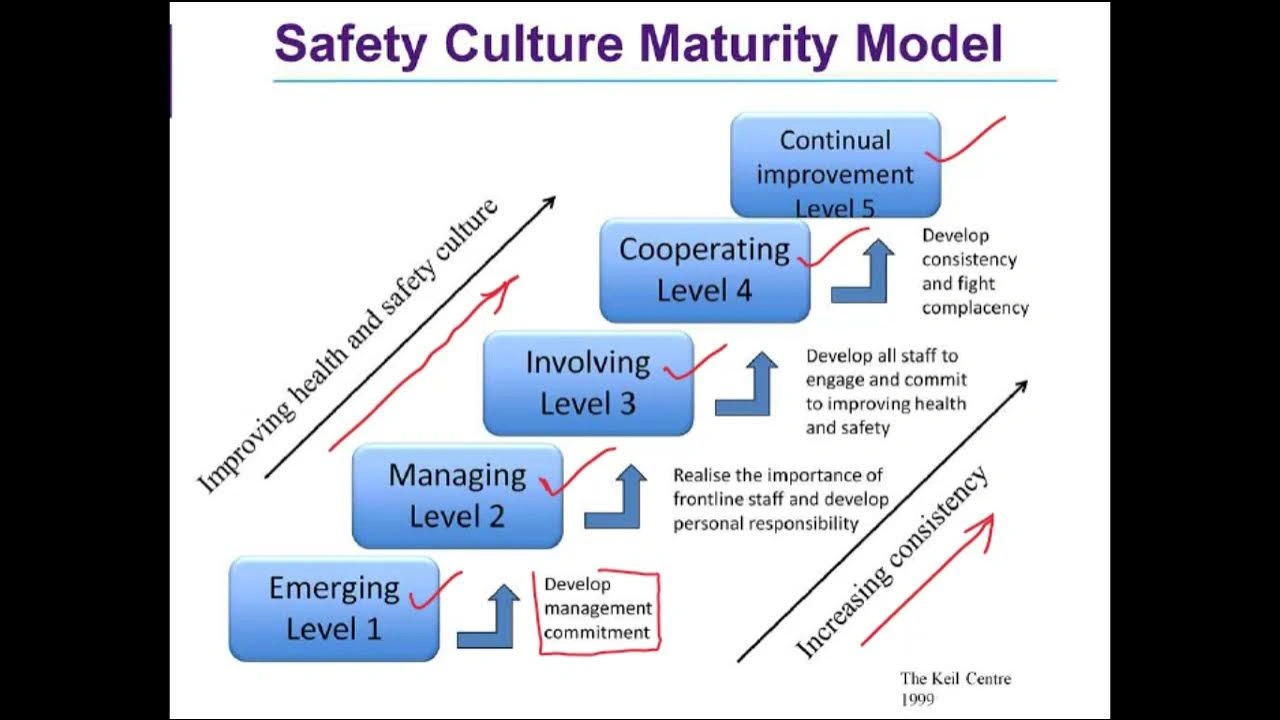
3. Fleming/Keil Centre Safety Culture Maturity Model (SCMM)
Overview
Developed by Mark Fleming of the Keil Centre, this Safety Culture Maturity Model (SCMM) was originally designed to help organisations in high-risk industries such as offshore oil and gas, aviation, and petrochemical sectors measure and improve their safety culture systematically. It builds on traditional maturity thinking but incorporates detailed elements of safety culture that influence maturity.
Model Characteristics
Unlike other models with simple level definitions, the SCMM uses up to 10 distinct safety culture elements, such as leadership commitment, communication, learning, participation, and trust. These elements are assessed across five levels of maturity:
1. Emerging
Safety is defined predominantly in terms of compliance and technical solutions. Leaders may view safety as external to core operations rather than a strategic priority. Front-line staff show low engagement, and safety incidents are often attributed to individual behaviour rather than systemic issues.
2. Managing
Organisations begin to recognise the business impact of safety. They invest in risk controls and compliance mechanisms, but often remain reactive. Management involvement increases, yet decision-making may still focus primarily on procedural adherence rather than cultural transformation.
3. Involving
Employee participation increases, and safety responsibilities extend beyond top leadership. Individuals and teams begin to share accountability for safety outcomes. Formal tools and programmes start being implemented to strengthen learning and engagement.
4. Cooperating
At this stage, departments and teams collaborate effectively on safety issues. There is consistent communication, shared learning from incidents, and cross-functional support for safety initiatives. Maturity begins to influence broader organisational systems and processes.
5. Continually Improving
The most mature level reflects an organisation that continuously evaluates and improves its safety systems. Leadership supports innovation in safety practices, employee feedback is actively sought and acted upon, and safety performance is routinely monitored against forward-looking indicators.
Practical Application
The SCMM is widely used in detailed organisational assessments because it combines cultural elements with maturity progression. This integration allows leaders to develop targeted improvement plans based on specific cultural attributes rather than generic descriptors.
Strengths
-
Comprehensive and detailed.
-
Connects cultural attributes with measurable maturity levels.
Limitations
-
More complex to apply without expert facilitation or assessment tools.
4. Westrum’s Organisational Culture Typology
Overview
Although not originally developed as a safety maturity model, Ron Westrum’s organisational culture typology (often cited in safety literature) provides a foundational framework for understanding how organisations handle safety-related information. It highlights how cultural norms influence communication and behaviour around risk.
Three Levels
Westrum’s framework describes three broad cultural types:
1. Pathological (Power-oriented)
Safety information is hidden, blame is prevalent, and leaders prioritise control over learning. Organisations with pathological cultures tend to suppress or minimise safety-related concerns, leading to dangerous blind spots.
2. Bureaucratic
Organisations at this level rely on formal rules and policies. Information flows are screened through procedures rather than open dialogue, and responsibility is limited to roles rather than shared values. Safety is managed primarily through compliance and enforcement rather than intrinsic commitment.
3. Generative
At the highest level, organisations openly share safety information and focus on learning from failures. Personnel are encouraged to raise concerns without fear of reprisal, and leadership actively supports continuous improvement. Safety becomes a collective value rather than a procedural requirement.
Practical Application
Westrum’s model is frequently referenced in safety culture assessments because it explains why certain safety behaviours emerge based on information flow and cultural norms. While not a full maturity ladder with procedural steps, it provides strong theoretical grounding for why organisations succeed or fail in safety culture improvement.
Strengths
-
Simple, conceptually rich cultural framework.
-
Highlights the importance of communication and information flow in safety performance.
Limitations
-
Not inherently a maturity model with explicit progression steps.
5. Consultivo’s SMILe Safety Maturity Index
Overview
Commercial models such as the Consultivo SMILe Safety Maturity Index adopt modern safety culture thinking and industry best practices to evaluate maturity across multiple dimensions like leadership, involvement, and engagement. Although proprietary, these models represent a practical adaptation of academic thinking for real-world implementation in diverse sectors.
Model Structure
The SMILe maturity index defines five stages:
-
Emerging: Compliance mindset with minimal cultural engagement.
-
Managing: Systematic practices and controls introduced.
-
Involving: Workforce participation and shared ownership.
-
Cooperating: Cross-functional collaboration and leadership visibility.
-
Continuous Improvement: Safety is deeply embedded as a core value.
Read Also: Do’s and Don’ts of a Great Safety Officer
Practical Application
Used in consulting engagements and transformation programmes, this model helps organisations map their culture against industry benchmarks and implement data-driven interventions. While less theoretically rich than academic models, it offers practical frameworks for step-by-step transformation.
Strengths
-
Easy to apply with clear indicators.
-
Focuses on actionable leadership and engagement behaviours.
Limitations
-
The proprietary nature may limit contextual adaptation.
Comparative Insights: Choosing the Right Model for Your Organisation
Academic vs Practical
-
Academic models like Hudson’s and Fleming’s SCMM provide strong explanatory power and cultural depth, ideal for research and holistic transformation.
-
Practical models like the Bradley Curve and SMILe offer simpler frameworks that are easier to communicate and implement.
Industry Context
-
High-risk industries (aviation, oil and gas, nuclear) may prefer comprehensive frameworks like SCMM due to their detailed cultural elements.
-
Organisations seeking quick diagnostic tools might adopt the DuPont Bradley Curve to align leadership and workforce understanding of safety culture stages.
Integration with Safety Management Systems
Most models complement, rather than replace, formal safety management systems (SMS). They help organisations embed cultural maturity alongside technical compliance and procedural controls, creating a balanced approach to safety excellence.
Read Also: 21 Essential Accident, Incident and EHS KPIs
Conclusion
Safety culture maturity models are essential tools for organisations seeking systematic pathways toward safety excellence. They help leaders understand where their organisation stands, why cultural issues persist, and how to progress strategically toward shared responsibility and continuous improvement.
Key progressions across most models include:
-
Movement from reactive, compliance-based practices to proactive, participative safety behaviours.
-
Shift from individual responsibility to collective ownership.
-
Integration of leadership commitment, communication, and learning as core enablers of higher maturity.
By selecting and applying the most appropriate model for their context, organisations can create robust roadmaps to enhance safety performance, build stronger cultural norms, and achieve sustainable organisational resilience.

A seasoned Health and Safety Consultant with over a decade of hands-on experience in Occupational Health and Safety, UBONG EDET brings unmatched expertise in health and safety management, hazard prevention, emergency response planning, and workplace risk control. With a strong passion for training and coaching, he has empowered professionals and organizations to build safer, more compliant work environments.
Certified in globally recognized programs including NEBOSH, ISO standards, and OSHA regulations, he combines technical know-how with practical strategies to drive health and safety excellence across industries. designing comprehensive HSE management systems or delivering impactful safety training, whether he] is committed to promoting a culture of safety and continuous improvement.